
Weight Loss Starts with Your Mindset and Habits
Stop Starting Over.
Create habits that make losing weight easier and more sustainable
If you know what you should be eating but find yourself struggling to do it consistently, perhaps you don't need another diet plan. Perhaps you need to understand what's getting in the way.
Traditional approaches to weight loss tend to focus on what to eat and how much to eat. And while good nutritional information matters, particularly when we're surrounded by so much conflicting advice, knowing what to eat often isn't enough to change what we actually do.
A Different Approach to Sustainable Weight Loss
Change the thinking underneath your eating
The Mindset Diet grew from my own experience of weight loss and from helping other women understand the thoughts, beliefs, emotions and habits that influence their relationship with food. Rather than focusing solely on what's on your plate, The Mindset Diet widens the lens. It explores
Thinking habits that can turn one choice into a "failed" day.
Routines that make some choices easier and others more difficult.
Cravings, emotional eating and eating when you're not physically hungry.
The influence of sleep, stress, self-care and your environment.
And the old beliefs and food rules you may have been carrying for far longer than you realise.
The aim isn't to control yourself more but to understand yourself better. When you understand what's driving a behaviour, you have more choice about what you'd like to do next.
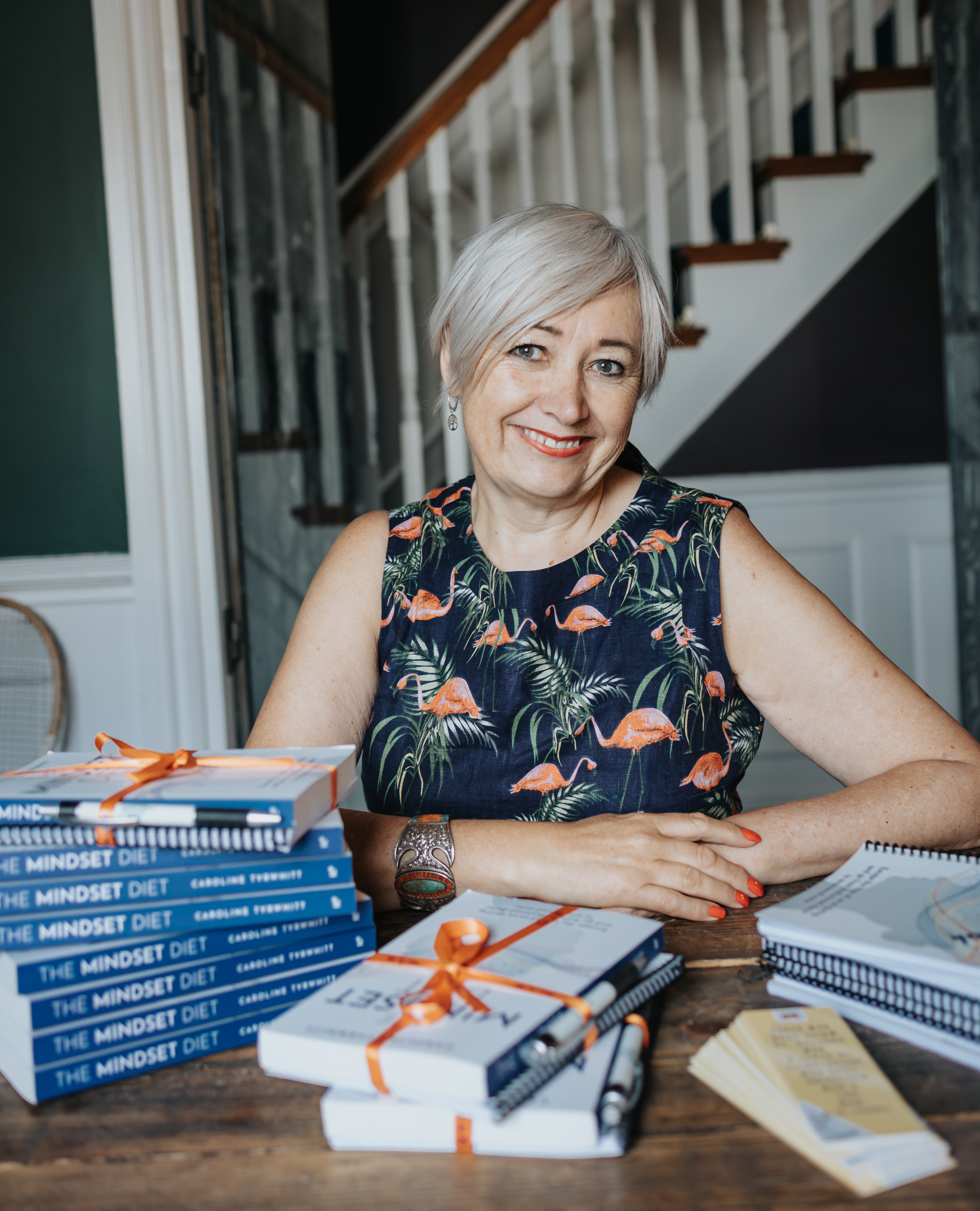
From disillusioned dieter to empowered eater
The Mindset Diet book is the foundation of my work and is designed to help those who are ready to move beyond the cycle of dieting, losing weight and regaining it.
Let me be clear, it's not another diet plan. The Mindset Diet is an invitation to understand the relationship between your thinking, your habits, your eating and the life you're living. It is an award-winning root-cause approach to sustainable weight loss.
The Mindset Diet takes a different approach.
I help women explore and change the underlying thinking, habits and everyday patterns that have contributed to weight gain and make it difficult to eat in the way they want to. Instead of relying on more rules, restriction or endless willpower, we look at what needs to change in everyday life so that your desired way of eating becomes easier to sustain.
Because the more intentionally you live, the easier it becomes to eat in the way you want to.
The ways to work with me
I advocate small changes at a time as this is an impactful yet sustainable approach. You can begin your journey in changing your relationship with food wherever feels right for you and choose the level of support that suits you now.
EXPLORE
"I'm curious. I'd like to understand more"
Perhaps you've never considered the power of mindset on your success. I invite you to start to understand your mind's influence over your eating.
You could: take my quiz, read my blogs, attend a free workshop, download a tip sheet or join my free community group.
Use these resources to start to explore your relationship with food, discover some of the thinking and habits that may be influencing you and start asking different questions.
Best for you if: you'd like to get to know my approach and begin exploring things in your own time.
DISCOVER
"There's something specific I'd like to change."
Perhaps cravings are getting in your way. Perhaps you'd like to create a habit that actually lasts. Perhaps you'd like to improve your self-belief.
My focused courses give you the opportunity to explore one area in greater depth and begin putting what you discover into practice. These courses are designed to stand alone, so you can work on the area that feels most relevant to you without feeling you have to tackle everything at once.
Or you can book an EmPower Hour with me to work on one area.
Best for you if: you've identified something specific you'd like to understand and change.
DEVELOP
"I'm ready to go deeper and change my relationship with food."
My membership group is a supported programme for women who want to work through the principles of The Mindset Diet and get support with the coaching activities in the book.
You will create change across your thinking, habits and relationship with food while being supported with accountability, mentorship and encouragement.
Rather than concentrating on one behaviour in isolation, you'll explore the patterns underneath it and gradually develop a more intentional way of living that supports both losing weight and sustaining that weight loss.
Best for you if: you're ready for deeper change and would value learning alongside other women with my support.
TRANSFORM
"I'm ready for this to become personal to me."
Sometimes you know you're ready to stop trying to work everything out alone but you don't want to be part of a group.
My six-month or one-year private coaching programme gives us the time and space to understand your patterns: your thinking, your history with food, your habits, your life and what you would like to change over an extended period of time.
Whilst we apply the principles of The Mindset Diet and I'll introduce you to NLP tools, there is no generic formula that we follow. We work with what emerges for you and what will create the life you actually want.
Best for you if: you'd like personalised support to create deeper, sustainable change.
MEET CAROLINE
"I know what it's like to know what to do, and still not do it"
My own experience of weight loss taught me that knowing what to eat was only part of the answer.
Some of the changes that ultimately made the biggest difference to me weren't dramatic: they were changes to my thinking, my routines and the habits that surrounded my eating. Over time, I stopped relying on willpower and began creating a way of living that supported the choices I wanted to make.
That experience changed the direction of my work and eventually became the thinking behind The Mindset Diet.
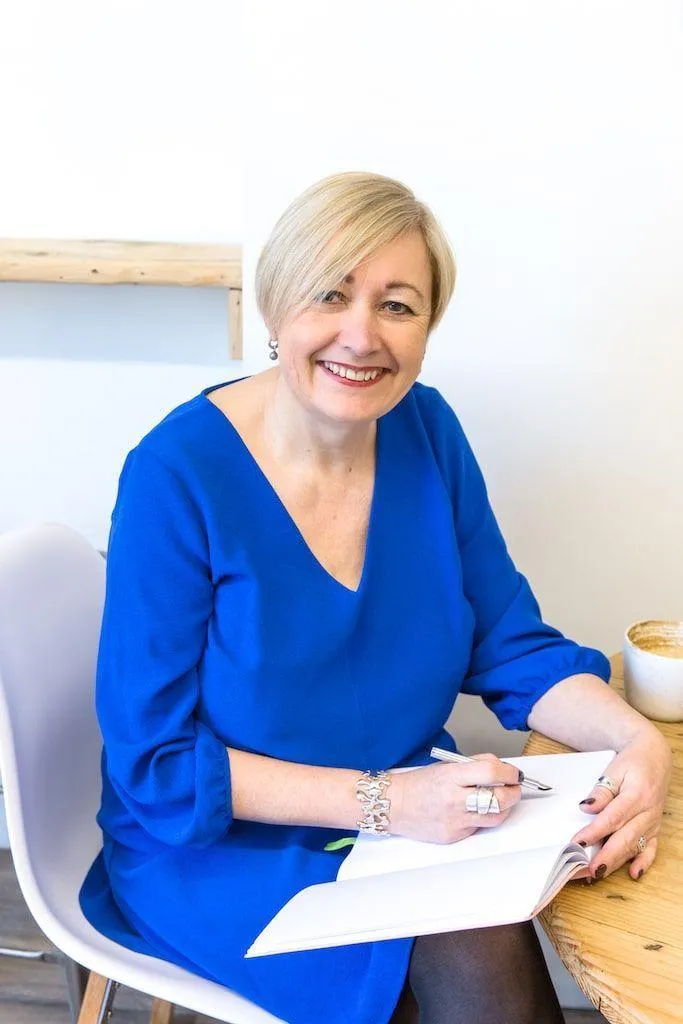
Today, I bring together my lived experience, my research, my coaching work and neurolinguistic programming (NLP) to help women become curious about what's really happening to them. I encourage you to look beyond your eating, without judgement, so you can create your own rules aligned with who you really are.
.
Because I believe lasting change becomes possible when we stop fighting ourselves and begin understanding ourselves.
From the blog
If you'd like to understand your thinking, habits and relationship with food in your own time, you'll find articles exploring the ideas at the heart of The Mindset Diet.
FEATURED ARTICLE
https://freetobenlp.co.uk/post/why-do-i-keep-losing-weight-and-gaining-it-back
Why Do I Keep Losing Weight and Gaining It Back?
Weight regain after dieting is not a failure of willpower. It is the predictable result of an approach that treats the symptom - weight gain - without addressing the habits, beliefs and triggers that caused it. The cycle has a name: yo-yo dieting. And there is a way out of it.

Client Testimonial
I one-hundred-percent recommend that you work with Caroline. I love her passion and that she's walked the talk.
When I look back at all the money I spent on slimming, which worked temporarily, it hit me that I needed to do inside work.
I can’t bear to think about being how I was, still. It’s like an addiction that struggle with food. You need the guidance of someone like Caroline and you need to put the work in to get rid of those dark days, to get rid of unpleasant thoughts around food.
I spend virtually no time thinking about food now, I am my ideal weight consistently and I don't sabotage.
I’m very confident that Caroline's guidance was the most helpful thing to me doing the mindset work. We went off piste several times looking at other blockages that didn't appear food related. That was where I got the massive value. The sessions alone, never mind the weight loss, gave me confidence.
I feel so wonderful in my clothes. It makes me smile. I feel very comfortable in myself.
Debra
AS FEATURED IN ...
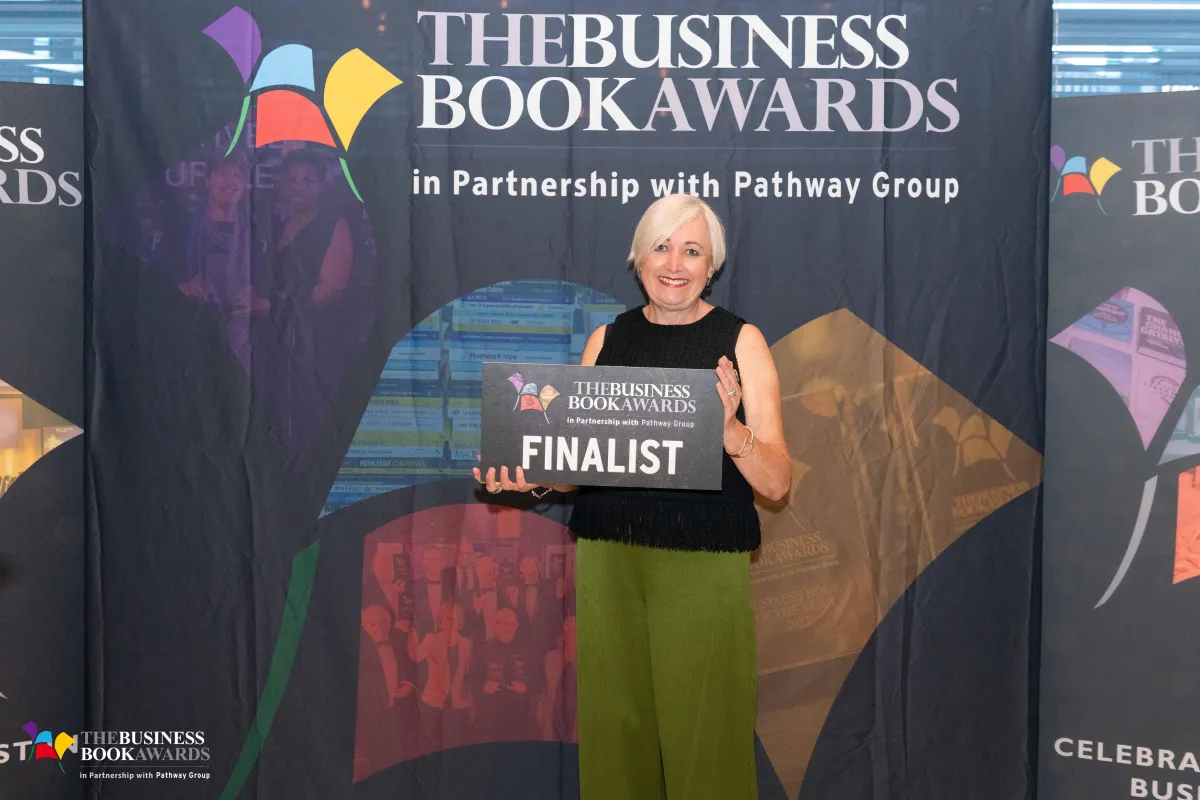
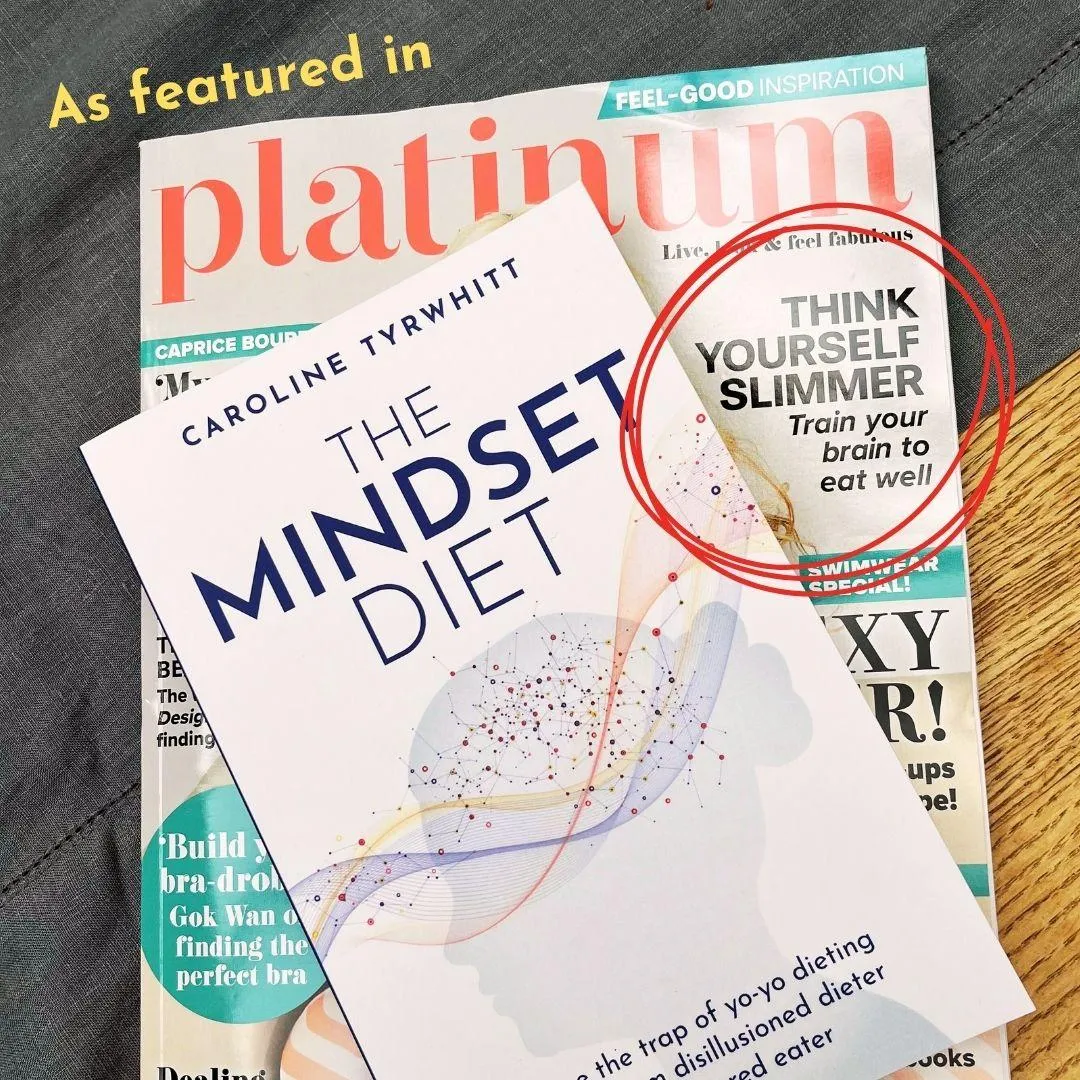
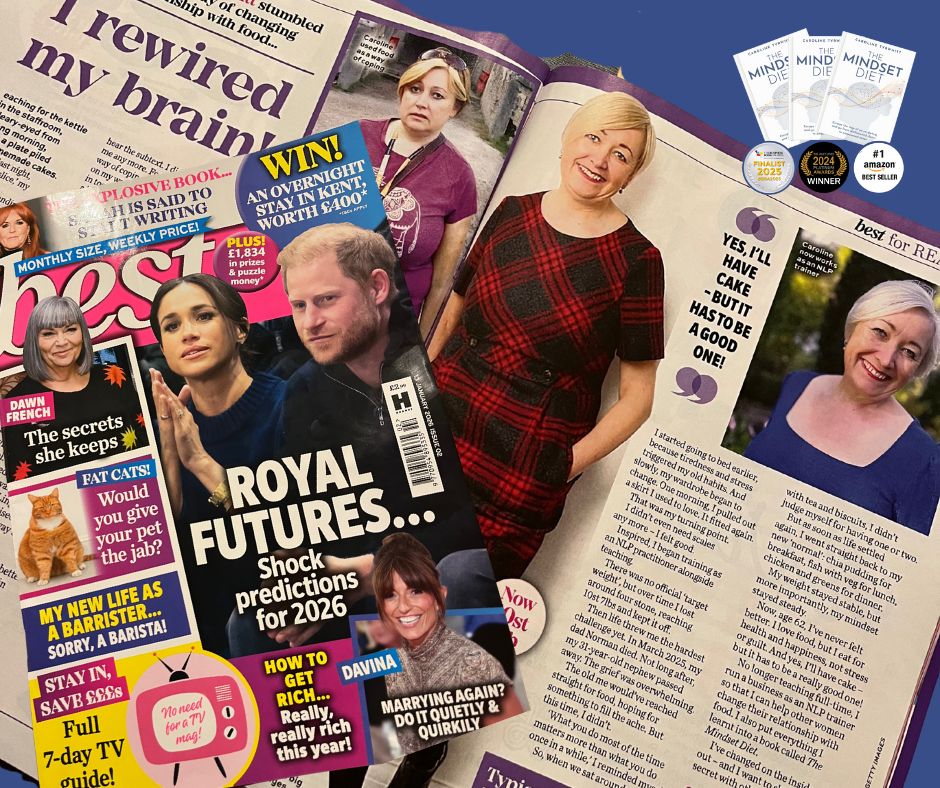
My work on mindset, sustainable weight loss and our relationship with food has been featured in podcasts, magazines and newspapers, and I have been invited to speak at events.
Print: Platinum magazine, Best magazine, Woman's Own, The Telegraph, London Daily News
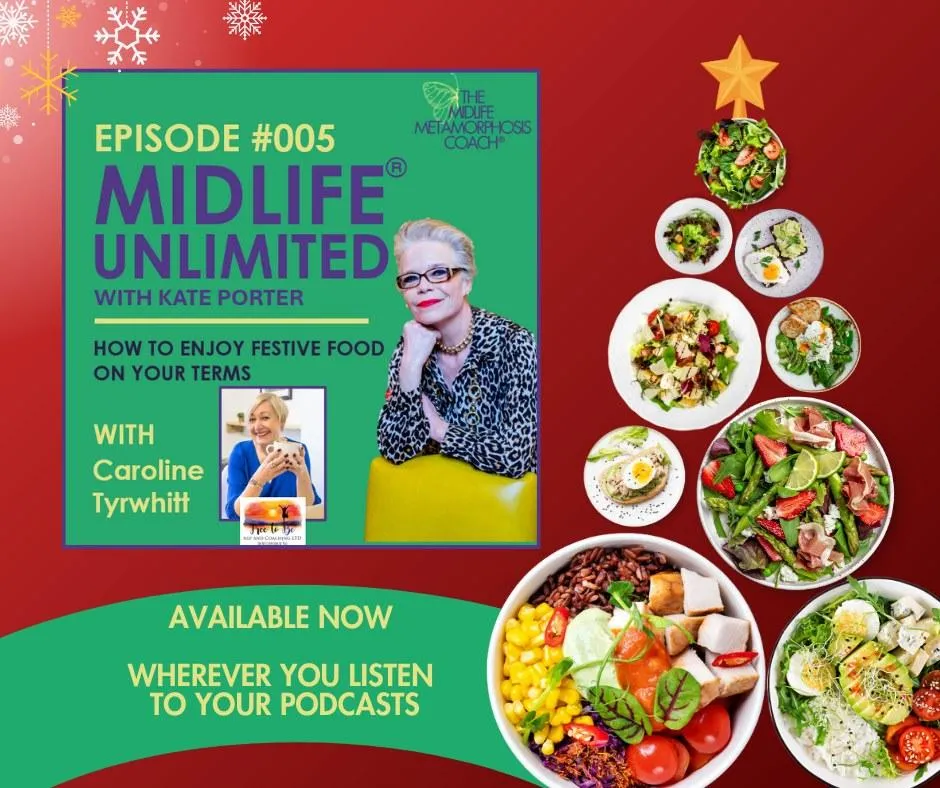
Podcasts: Alcohol Free Life with Janey Lee Grace, Midlife Unlimited with Kate Porter, She Feels Good with Sheryl Naidu.
You don't have to change everything today or promise yourself that Monday will be different, or wait until you feel more motivated...
You can begin by simply becoming curious about what would become easier if you changed just one habit ...
Wherever you are now, there's a place to begin. Call me and let's work it out together.
You Don't Need to Try Harder



Copyright 2026 © All Rights Reserved.


